American Mahjong — A Beginner's Reference
Companion page for an upcoming beginner's book teaching American-style Mahjong as one complete, consistent rule system, by Allen S.C. Choi, published by PicoBlu LLC.
Why One Rule System
American Mahjong is played several genuinely different ways around the world. Learning three rule systems at once, from three different sources, is the fastest way to get confused at an American table.
Every diagram in the book uses one tile set and one notation system (taught in Chapter 3), so a hand written on page 40 reads the same way on page 200. The book does not reproduce any specific year's card of standing hands — it teaches the game underneath the card, so what you learn transfers to whatever card your own table plays with.
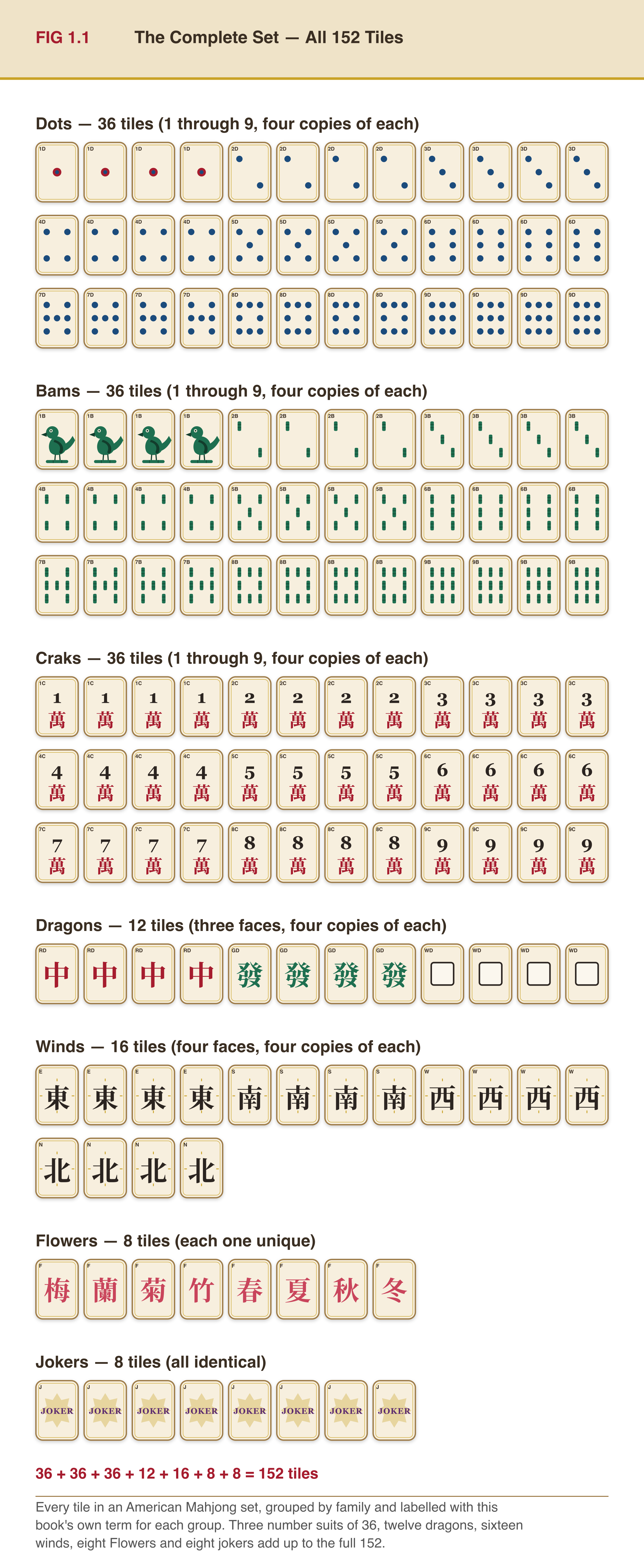
Quick Reference: What's In the Box
A complete American Mahjong set holds 152 tiles:
| Family | What's in it | Count |
|---|---|---|
| Dots, Bams, Craks | 1–9, four copies each, three suits | 108 |
| Dragons | Red, Green, White — four copies each | 12 |
| Winds | East, South, West, North — four copies each | 16 |
| Flowers | eight, each one different | 8 |
| Jokers | eight, all identical | 8 |
| Total | 152 |
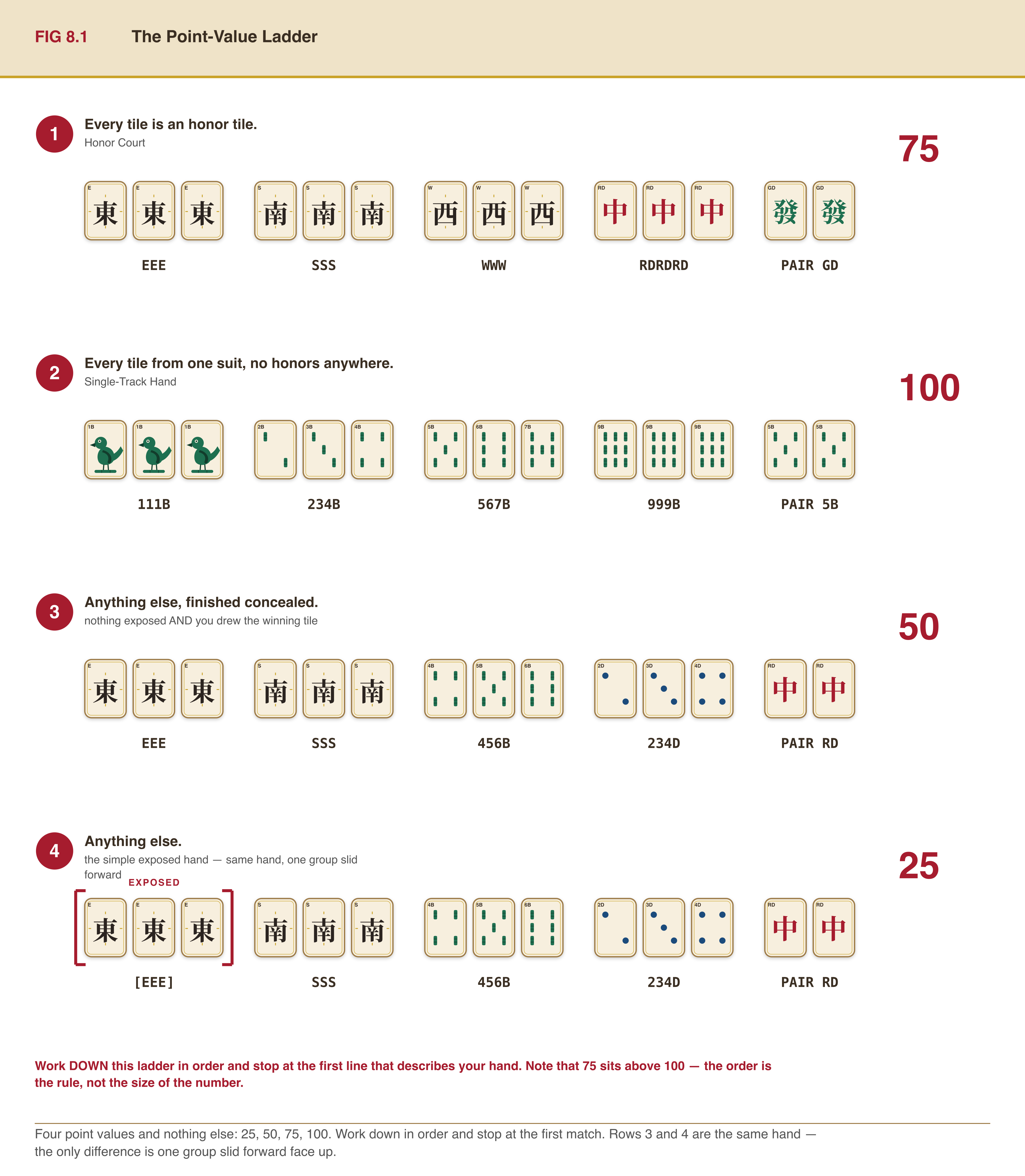
A complete hand is four groups and a Pair — fourteen tiles (a Pung, Kong, or Run per group; add one tile per Kong).
Tile Basics: The Three Suits and the Honor Tiles
Every number tile belongs to one of three suits, and each suit runs 1 through 9, four copies of every number.
| Suit | Where the name comes from | What it looks like |
|---|---|---|
| Dots | Nickname for the round pips printed on the tile. Some tables call it Circles — this reference uses Dots. | A cluster of colored pips, one per count in the number. |
| Bams | Short for Bamboo. | A row of narrow vertical shapes, except the 1-bam, which usually shows a bird instead. |
| Craks | Short for Character. | A printed numeral, with a matching Chinese numeral symbol below it. |
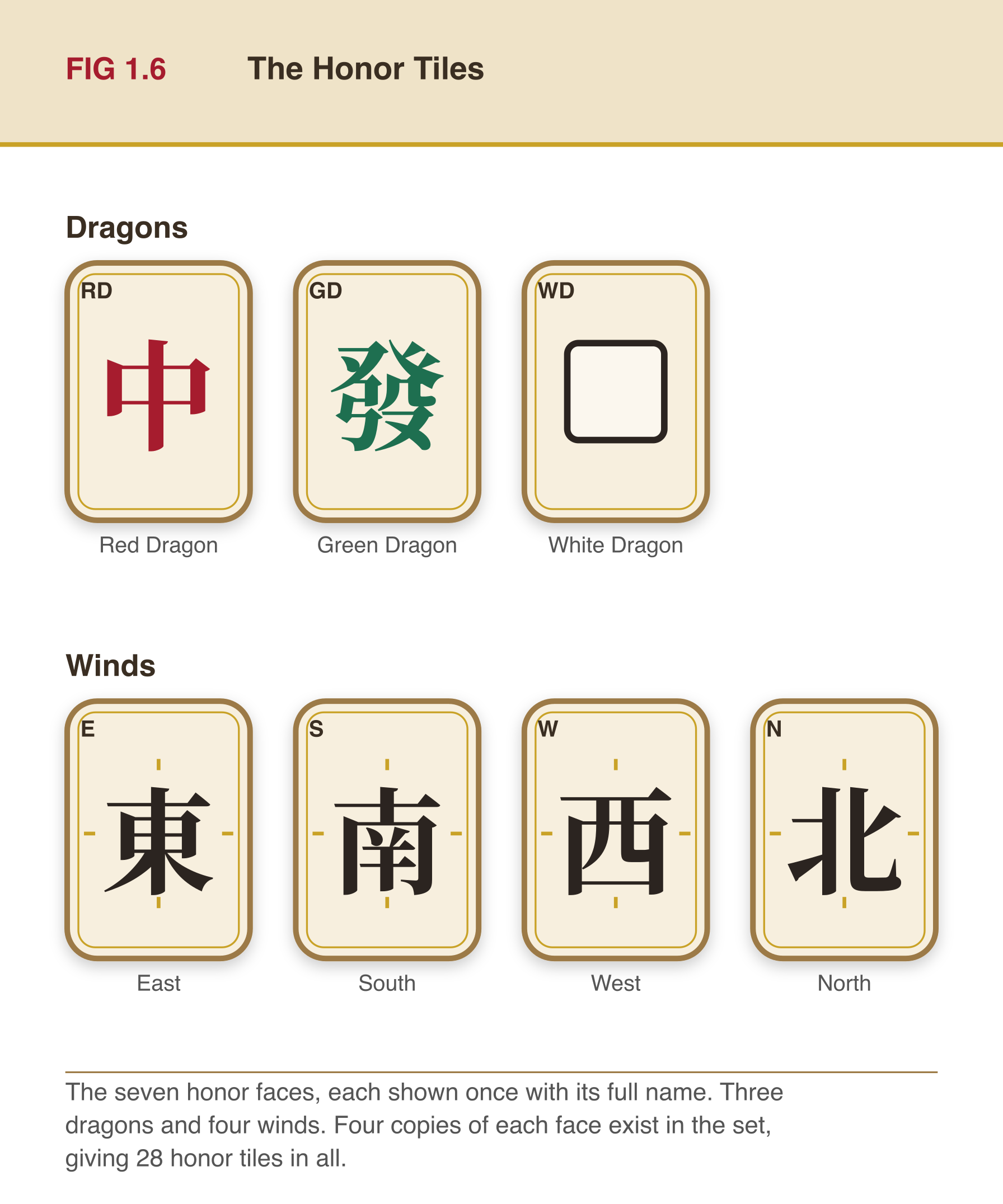
Honor tiles don't belong to a number suit. Three Dragons — Red, Green, White — four copies each. The White Dragon is usually left blank, or shows a plain border; some tables nickname it Soap. Four Winds — East, South, West, North — four copies each.
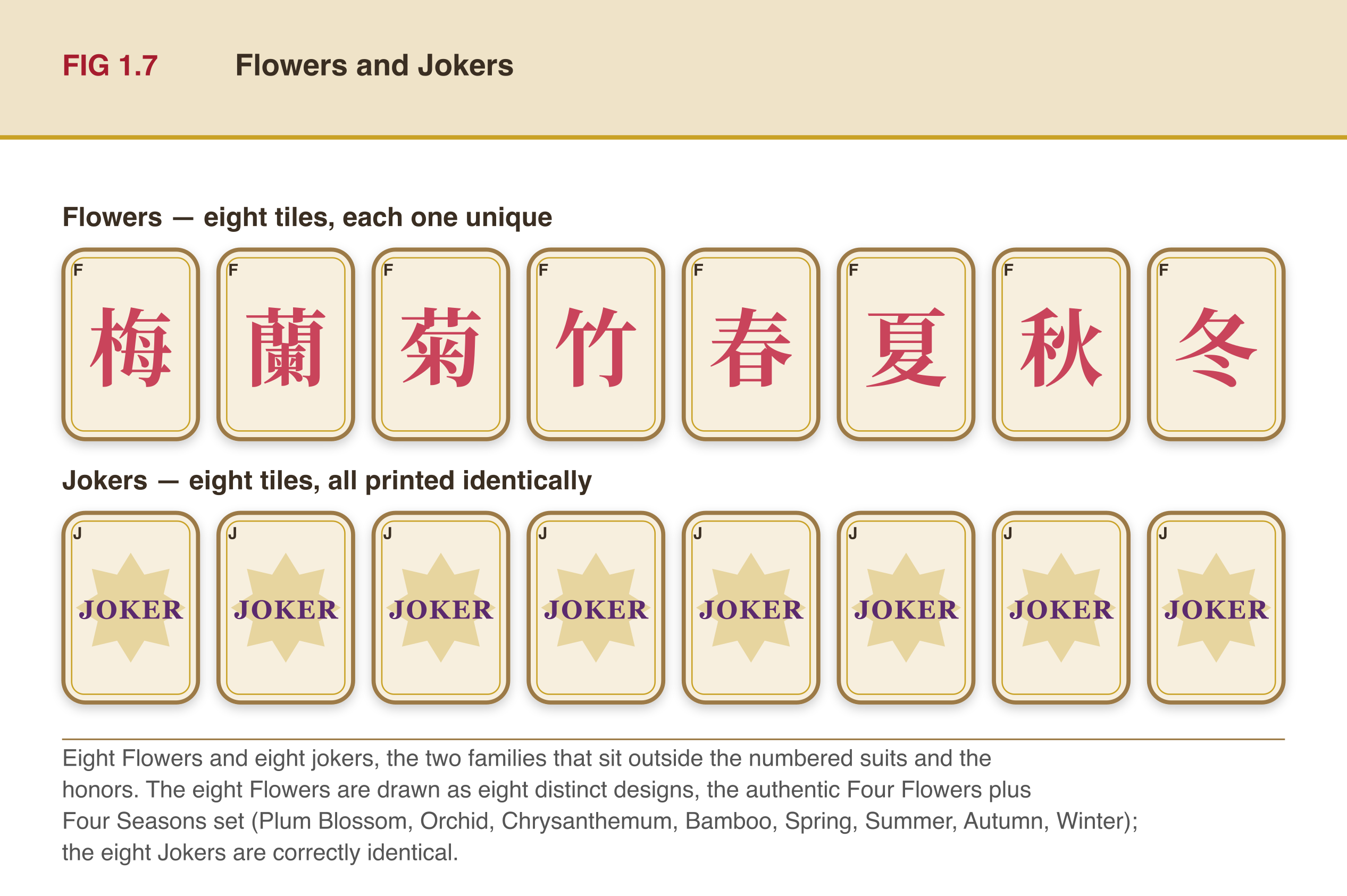
Two more families round out the 152-tile set: Flowers, eight tiles, each one unique — picking one up earns a replacement draw instead of building into your hand — and Jokers, eight tiles, wild, standing in for other tiles inside a hand.
Quick Rules Overview: The Charleston, Turns, and Winning
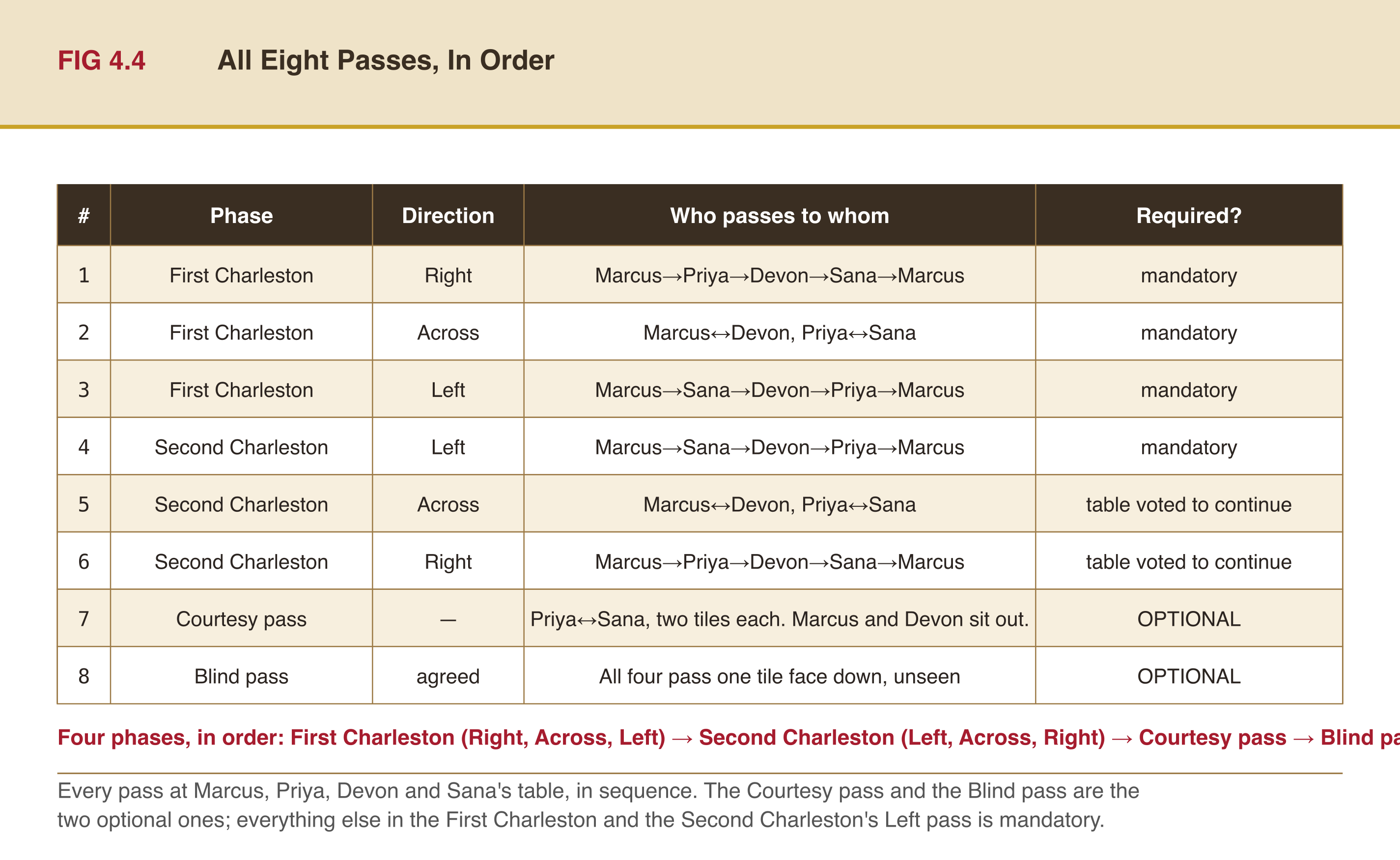
The Charleston is the tile-passing sequence that runs after the deal and before the first turn, always the same order:
| Phase | Order | Required? |
|---|---|---|
| First Charleston | Right, Across, Left | All three mandatory |
| Second Charleston | Left, Across, Right (reversed) | Only Left is mandatory; the table votes on Across and Right |
| Courtesy pass | runs after the Second Charleston finishes | Optional — two players agree to trade an equal number of tiles, up to three each |
| Blind pass | runs last | Optional — tiles pass face down, unseen by the passer |
One tile never leaves your hand in any of these passes: the Joker. It is never passed during the First Charleston, the Second Charleston, or the Courtesy pass.
Once the Charleston ends, play moves in a cycle: draw a tile from the Wall, then discard one, dropping back to thirteen. A Pung or Kong can be called by any player; a Run can only be called by the player whose turn comes next.
A hand is won one of two ways, and the way you won it decides who pays:
- Self-draw win — you complete your hand with a tile you drew yourself from the Wall. Every other player pays double the hand's base point value.
- Discard win — you complete your hand by calling a tile another player discarded. That player pays double the base amount; the other two players each pay the base amount once — not zero.
Contents of the Book
Get in Touch
A dedicated contact address for this site is not live yet. Placeholder, not a working address: [CONTACT EMAIL — coming soon]